Microservices Topology and Service Catalog¶
Status: Draft for approval Scope: Kubernetes-only, microservice-based target architecture
1. Topology Overview¶
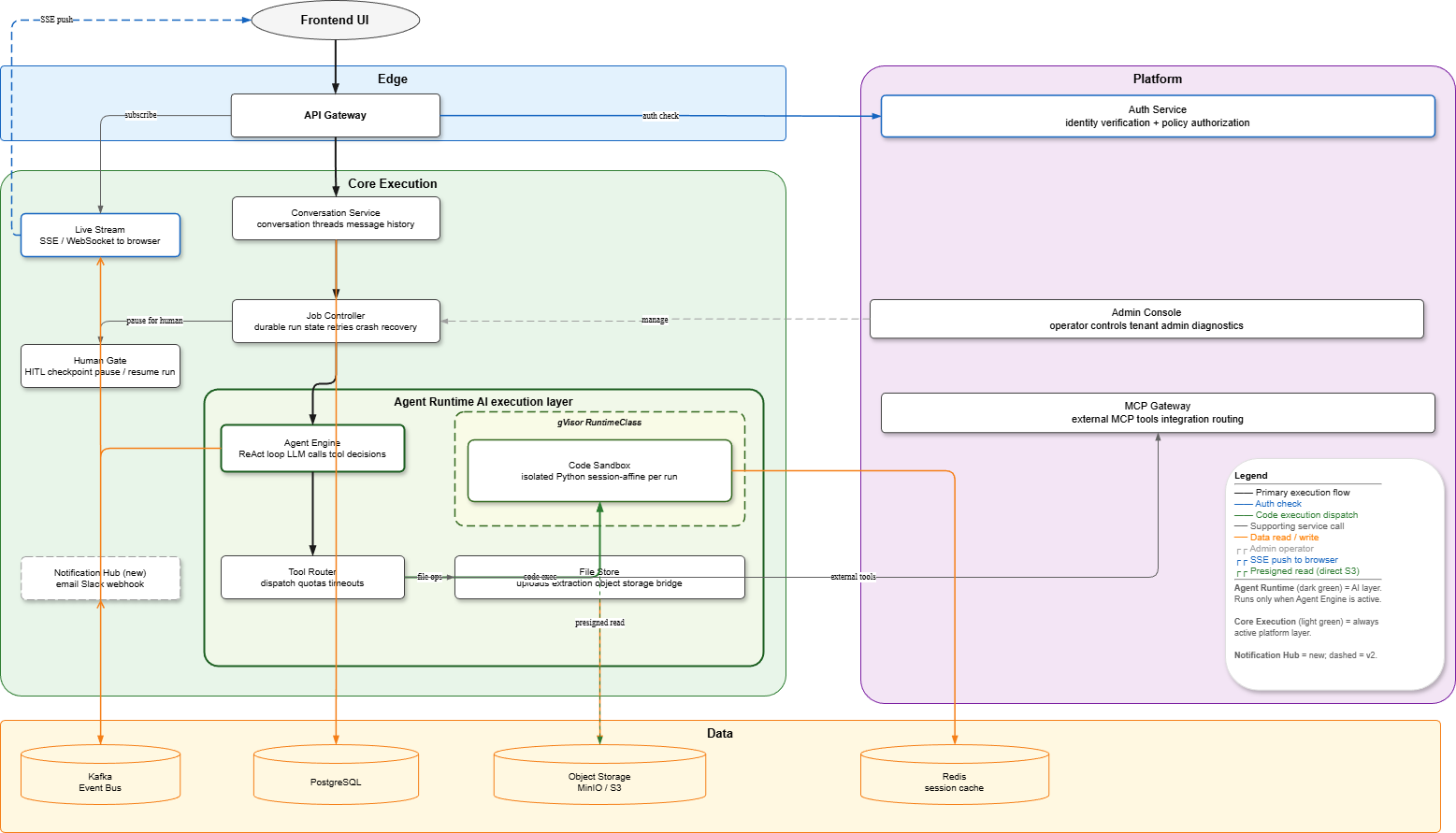
Mermaid fallback (text-based, auto-layout)
flowchart TB
  UI([Frontend UI])

  subgraph Edge[Edge]
    GW[API Gateway]
  end

  subgraph Platform[Platform]
    AU[Auth Service\nidentity + policy]
    MG[MCP Gateway\nexternal tools]
    AD[Admin Console]
  end

  subgraph Core[Core Execution]
    LS[Live Stream\nSSE delivery]
    HG[Human Gate\nHITL checkpoint]
    NH[Notification Hub\nemail · Slack]
    SS[Conversation Service\nthreads · history]
    JC[Job Controller\ndurable run state]

    subgraph AR[Agent Runtime · AI execution layer]
      AE[Agent Engine\nReAct loop · LLM]
      TR[Tool Router\ndispatch · quotas]
      subgraph Sandbox[gVisor RuntimeClass]
        CS[Code Sandbox\nisolated Python]
      end
      FS[File Store\nuploads · extraction]
    end
  end

  subgraph Data[Data]
    PG[(PostgreSQL)]
    RE[(Redis)]
    OS[(Object Storage)]
    MQ[(Event Bus)]
  end

  %% ── Primary execution flow ──────────────────────────────────────────────
  UI --> GW --> SS --> JC --> AE --> TR

  %% ── Auth ────────────────────────────────────────────────────────────────
  GW -->|auth check| AU

  %% ── SSE delivery ────────────────────────────────────────────────────────
  GW -->|subscribe| LS
  LS -->|SSE push| UI

  %% ── Human Gate (HITL) ───────────────────────────────────────────────────
  JC -->|pause for human| HG

  %% ── Tool dispatch ───────────────────────────────────────────────────────
  TR -->|code exec| CS
  TR -->|file ops| FS
  TR -->|external tools| MG

  %% ── Admin operator ──────────────────────────────────────────────────────
  AD -.->|manage runs| JC

  %% ── Data connections ────────────────────────────────────────────────────
  SS --> PG
  JC --> PG
  CS --> RE
  FS --> OS
  CS -. presigned read .-> OS
  AE --> MQ
  MQ -->|fan-out| LS
  MQ -->|fan-out| NH
Architecture principles visible in this diagram
Concern How it is addressed Single auth hop Auth Service merges Identity + Policy — every request does one auth check before reaching Core Clear execution chain Conversation Service (history) → Job Controller (durability) → Agent Engine (AI loop) → Tool Router (dispatch) forms an unambiguous top-to-bottom path Job Controller owns durability Crash recovery, retries, pause/resume, and idempotency live in Job Controller; Agent Engine is stateless between steps Human Gate is a checkpoint When a run needs human approval, Job Controller suspends to Human Gate; Human Gate resumes the run when the human responds Tool Router fans out cleanly Code Sandbox (gVisor) for execution, File Store for files, MCP Gateway for external tools — three distinct targets with no overlap Sandbox reads directly Code Sandbox fetches user files via presigned S3/MinIO URL with no mediator; outputs return through File Store → Object Storage Event Bus drives delivery Live Stream and Notification Hub are pure consumers of Event Bus — they never call upstream services Offline gap filled Notification Hub (v2 addition) delivers to email/Slack/webhook when the user is not connected to SSE
2. Service Boundaries¶
API Gateway¶
Was: Gateway BFF - Owns: edge routing, rate limiting, auth token verification (delegates to Auth Service), stream channel fan-out. - Does not own: business workflow state, tool execution, authorization policy rules. - Scale pattern: CPU and connection-based HPA.
Auth Service¶
Was: Identity Auth Service + Policy Authorization Service (merged) - Owns: user authentication, token/session lifecycle, service account identity, role policy, tenant/workspace authorization checks. - Does not own: business domain command decisions. - Why merged: every inbound request requires both identity resolution and policy check in the same call — two round-trips with no benefit at V1. - Scale pattern: stateless token handlers with low-latency decision cache.
Conversation Service¶
Was: Session Service (v3), Conversation Service (v1) - Owns: conversation threads, message records, history query APIs, conversation-level ownership. - Does not own: run execution state or agent loop logic. - Scale pattern: read-heavy autoscaling, indexed query store backed by PostgreSQL.
Job Controller¶
Was: Run Manager (v3), Workflow Orchestrator (v1) - Owns: durable run state machine, retries, cancellation, pause/resume, idempotency keys, crash recovery checkpoints. - Does not own: LLM calls or ReAct loop logic — delegates all agent execution to Agent Engine. - Key distinction from Agent Engine: Job Controller survives a pod crash and can resume from the last checkpoint. Agent Engine cannot. - Scale pattern: partition by tenant/workspace and run ID.
Agent Engine¶
Was: Agent Runtime Service - Owns: the ReAct reasoning loop — calls the LLM, reads the response, decides which tool to call, iterates until done. - Does not own: durable state between steps. Each step is handed to Job Controller for checkpointing before the next step begins. - Key distinction from Job Controller: Agent Engine is the AI brain. Job Controller is the supervisor that keeps it alive across failures. - Scale pattern: queue-driven workers with GPU/CPU concurrency controls.
Human Gate¶
Was: HITL Approval Service - Owns: human-in-the-loop checkpoint lifecycle — captures approval requests, stores pending decisions, resumes Run Manager on human response. - Does not own: model execution or run state. - Flow: Job Controller → Human Gate (suspends) → human responds → Human Gate → Job Controller resumes. - Scale pattern: event-driven, durable state for reconnect safety.
Tool Router¶
Was: Tool Executor Service - Owns: tool dispatch to the right capability (Code Sandbox, File Store, MCP Gateway), per-tool quota and timeout enforcement, result aggregation. - Does not own: tool implementation — it routes, it does not execute. - Scale pattern: worker pool by tool class and risk tier.
Code Sandbox¶
Was: CI Session Manager + gVisor Sandbox Pool - Owns: stateful sandboxed Python execution per run session, package installation, structured output capture (text, data, files, images). - Does not own: file persistence — outputs are returned to Tool Router → File Store. - Runtime: gVisor (runtimeClassName: gvisor) — isolated user-space kernel, ~5 ms startup, no KVM required. - Session model: session-affine pod routing (consistent-hash by session_id) so Python state (variables, imports, loaded data) persists across agent calls within the same run. - File reads: presigned S3/MinIO URL → pod fetches directly from Object Storage (no mediator). - Scale pattern: Deployment with session-affinity HPA on CPU. Redis holds live session→pod bindings.
File Store¶
Was: Artifact Service - Owns: file uploads, extraction pipeline (PDF, images, audio), artifact metadata, object storage persistence. - Does not own: policy decisions or code execution. - Scale pattern: async jobs for heavy extraction; HPA on queue depth.
Live Stream¶
Was: Stream Projection Service - Owns: SSE/WebSocket delivery of live events (text chunks, tool calls, task updates) to the connected browser. - Does not own: business command handling — it is a pure read-only consumer of Event Bus. - Scale pattern: connection and event throughput autoscaling.
Notification Hub¶
New in v2 — fills identified gap - Owns: async out-of-band delivery when the user is offline — email, Slack, webhook. - Does not own: SSE streaming (that is Live Stream's job). - Trigger: subscribes to run.completed / run.failed / hitl.pending events from Event Bus. - Scale pattern: event-driven workers, low steady-state load.
MCP Gateway¶
Was: MCP Registry Gateway - Owns: MCP app/tool registration, capability metadata, routing to external MCP servers. - Does not own: tenant policy decisions. - Scale pattern: registry cache + integration health polling.
Admin Console¶
Was: Admin Control Plane - Owns: operator APIs (drain, kill, diagnostics), tenant administration, runtime controls. - Does not own: direct execution path for user chat. - Scale pattern: low traffic, high security hardening.
3. Synchronous and Asynchronous Paths¶
Sync (request/response)¶
- Frontend → API Gateway → Auth Service (every request)
- API Gateway → Conversation Service (create thread, load history)
- API Gateway → Live Stream (SSE subscription setup)
- Admin UI → Admin Console
Async (event-driven)¶
- Conversation Service command → Job Controller enqueue
- Job Controller → Agent Engine via work queue
- Agent Engine → Event Bus (step completed, tool called, text chunk)
- Event Bus → Live Stream (fan-out, browser delivery)
- Event Bus → Notification Hub (fan-out, offline delivery)
- Human Gate request/response via Event Bus
- Tool Router dispatches are async internally (queue per tool class)
4. First Approval Checklist¶
- Confirm all 13 listed services are in scope for V1 platform topology.
- Confirm API Gateway remains thin — no orchestration logic.
- Confirm Auth Service merger (Identity + Policy) is acceptable; split if compliance requires separate deployments.
- Confirm Job Controller is the durable source of truth for all long-running runs.
- Confirm Agent Engine is stateless between steps — all state checkpointed by Job Controller.
- Confirm Live Stream is a pure Event Bus consumer — no business command handling.
- Confirm Notification Hub is in scope for V1 or explicitly deferred to V2.
- Confirm Code Sandbox uses gVisor runtime (not Firecracker) — see §5.
- Confirm data storage ownership in this doc aligns with governance requirements.
5. Sandbox Runtime Decision: gVisor vs Firecracker vs Kata¶
Requirements¶
| Requirement | Description |
|---|---|
| Sandboxed execution | Agent-generated code must not be able to escape to host or affect other tenants |
| Stateful sessions | Same session reuses the same interpreter — variables, imports, loaded data persist between agent calls |
| Object storage access | Code can read/write files in MinIO/S3 (user thread-scoped files) |
| K8s native | Must run in normal K8s pods without custom hardware requirements |
Option Comparison¶
| Criterion | gVisor ✅ Chosen | Firecracker | Kata Containers |
|---|---|---|---|
| Isolation mechanism | User-space kernel (Sentry intercepts all syscalls) | Full separate microVM per session via KVM | Lightweight VM per pod (QEMU or Firecracker hypervisor) |
| Startup latency | ~5ms (container speed) | ~125ms cold VM boot | ~500ms–2s (QEMU) / ~150ms (FC hypervisor) |
| Session statefulness | ✅ Python pod stays alive, process is persistent between calls | ✅ microVM process persists per session | ✅ pod persists |
| KVM / bare-metal required | ❌ No — works on any node | ✅ Yes — /dev/kvm, nodeSelector, privileged | ✅ Usually yes |
| K8s deployment type | Deployment + runtimeClassName: gvisor | StatefulSet (in-process VMPool can't share across workers) | Deployment + runtimeClassName: kata-containers |
| Node provisioning | DaemonSet to install gVisor binary only | DaemonSet to provisio kernel .bin + rootfs.ext4 + modprobe vhost_vsock | Less setup (Kata bundles its own guest kernel) |
| Object storage access | ✅ Normal Python HTTP (boto3 / urllib) through gVisor net stack | ✅ VM has network, but VSock I/O adds complexity for object storage | ✅ Normal container networking |
| CPU perf for compute | ✅ Near-native (no instruction emulation) | ✅ Native in VM | ✅ Native in VM |
| Syscall overhead | ~5-10x for heavy-syscall workloads; negligible for compute-heavy code | None beyond vsock roundtrip | Minimal |
| Operational complexity | Low — just a RuntimeClass and DaemonSet | High — StatefulSet, KVM nodes, rootfs builds, node taint management | Medium |
| Security level | High — no syscall passes through to host kernel | Very high — separate kernel | High — VM boundary |
Recommendation: gVisor¶
For AI agent code execution with stateful sessions, gVisor is the right fit:
-
Statefulness is trivial: a gVisor pod is just a container. The Python process runs for the lifetime of the session pod. No VMPool, no vsock, no warm pool management needed.
-
Object storage access is native: the sandboxed process calls
boto3.client('s3').download_file(...)orurllib.request.urlretrieve(presigned_url, '/tmp/data.csv')— normal Python HTTP through gVisor's network stack. No special bridging needed for reads. Writes go via Tool Executor → Artifact Service. -
No specialized hardware: any K8s node can run gVisor pods. No
nodeSelector: {firecracker: "true"}, no/dev/kvmhostPath volumes, no rootfs/kernel asset management. -
CPU-intensive code is near-native: numpy, pandas, matplotlib, sklearn — these are CPU-bound. gVisor adds zero overhead to raw CPU execution. Only syscall-heavy patterns (high-frequency small I/O) are slower, which is atypical for analytical code.
-
Simpler architecture: drop StatefulSet, VMPool, SessionManager, vsock protocol, and guest agent complexity. Replace with: Deployment +
runtimeClassName: gvisor+ session-affinity routing.
When Firecracker would be preferred¶
- Public-facing code playground open to arbitrary untrusted users (full kernel isolation is critical)
- Regulatory compliance requiring hypervisor-level tenant separation (e.g., PCI-DSS, FedRAMP)
- Workloads that need to run arbitrary OS-level operations (kernel modules, raw socket manipulation)
gVisor K8s Setup (summary)¶
# 1. Install gVisor on nodes (DaemonSet)
#    https://gvisor.dev/docs/user_guide/containerd/
# 2. Create RuntimeClass
apiVersion: node.k8s.io/v1
kind: RuntimeClass
metadata:
  name: gvisor
handler: runsc
---
# 3. Code Interpreter pod spec
spec:
  runtimeClassName: gvisor
  containers:
  - name: code-interpreter
    image: code-interpreter:latest
    # No --workers 1 constraint — process is stateful but in the pod, not VMPool
    # Session affinity on Service routes same session_id to same pod