runtime/ — Durable Execution Machinery
Source:
kernel/runtime/ids.py·kernel/runtime/log_entry.py·kernel/runtime/effects.py·kernel/runtime/inbox.py·kernel/runtime/scheduler.py·kernel/runtime/supervisor.py·kernel/runtime/wakeup.py·kernel/runtime/follow_graph.py·kernel/runtime/fanout.py·kernel/runtime/communication.py
The deepest part of the kernel. These contracts make agent runs survive crashes, scale across workers, and resume correctly after sleeping for hours — without the agent author doing anything special.
Run Lifecycle
stateDiagram-v2
    [*] --> PENDING : enqueue()
    PENDING --> RUNNING : lease(worker_id)
    RUNNING --> SUSPENDED : release(SUSPENDED) + Wakeup stored
    SUSPENDED --> PENDING : wake_suspended() / timer / signal / child_done
    RUNNING --> COMPLETED : release(COMPLETED)
    RUNNING --> FAILED : release(FAILED)
    RUNNING --> CANCELLED : release(CANCELLED)
    FAILED --> PENDING : retry_policy.max_retries not exhausted
    FAILED --> [*] : retries exhausted → dead-run
    COMPLETED --> [*]
    CANCELLED --> [*]

    note right of SUSPENDED : Zero RAM, zero CPU\nJust rows in storage\nWaits for Wakeup
    note right of FAILED : RunRetryPolicy governs\nmax_retries and backoff_s
SUSPENDED is the efficient idle state — a run waiting for a message, timer, signal, or child completion costs nothing while suspended.
The Full Execution Flow
Every agent execution follows a structured, durable execution flow managed by the runtime:
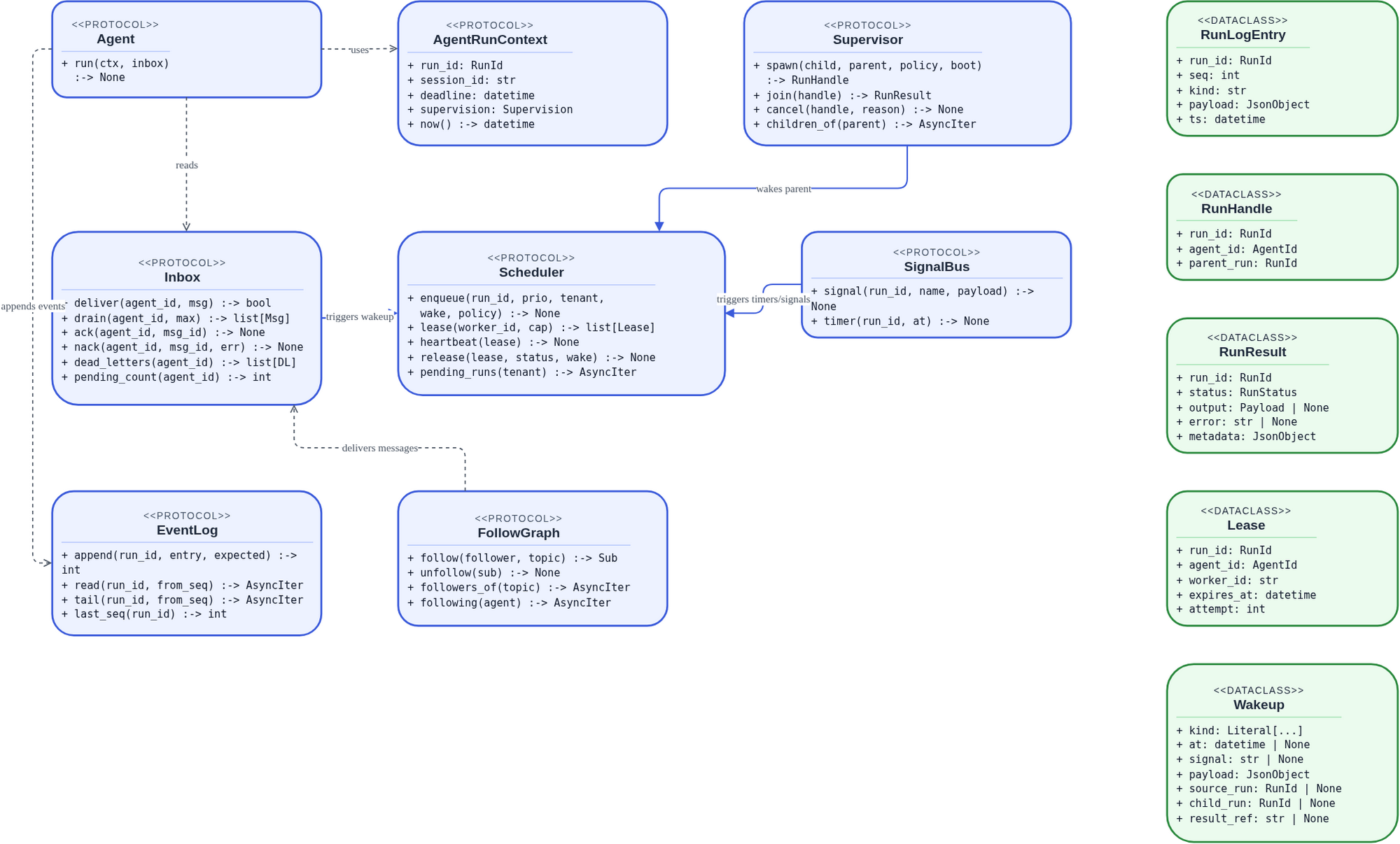
EventLog — Source of Truth
A run's state is always fold(all entries from seq=0). There is no separate state table. On crash, any worker can pick up the run, replay the log, and continue from exactly where it left off.
EventLog Protocol
| Method | Parameters | Description |
|---|---|---|
append | run_id, entry, expected_seq | Append a new log entry (throws ConcurrentAppendError on mismatch). |
read | run_id, from_seq | Read log entries sequentially. |
tail | run_id, from_seq | Live-stream log entries. |
last_seq | run_id | Retrieve the latest sequence ID. |
RunLogEntry Schema
| Field | Type | Description |
|---|---|---|
run_id | RunId | Target run execution ID. |
seq | int | Sequential log index. |
kind | str | Event type (e.g., run.started, msg.received, tool.called, run.completed). |
payload | dict | Metadata dictionary payload. |
ts | datetime | Log timestamp. |
Journal — At-Most-Once Side-Effects
Prevents executing the same side-effect twice when a worker crashes mid-tool.
sequenceDiagram
    autonumber
    participant Agent
    participant Journal
    participant External as External Service

    Agent->>Agent: effect_id = Effect.make_id(run_id, step_seq, "email.send", args)
    Agent->>Journal: lookup(effect_id)

    alt Cache HIT (replay path)
        Journal-->>Agent: EffectResult (cached)
        Note over Agent: Return cached result<br/>Do NOT re-execute
    else Cache MISS (first execution)
        Journal-->>Agent: None
        Agent->>External: send_email(to, subject, body)
        External-->>Agent: 200 OK
        Agent->>Journal: record(EffectResult(effect_id, "ok", {msgId: ...}))
    end
The crash window: If the worker dies after execute() but before record(), the effect may have happened without a journal entry. On replay the miss path runs again — the effect executes twice in that window. This is at-most-once's trade-off: we never double-send on record failures, but the crash window is unavoidable. Tools that are genuinely idempotent (GET calls, Stripe with idempotency key) are safe to re-run and should say so in their description.
Effect.make_id() is deterministic: SHA-256 of {run_id, step_seq, kind, args} with sorted keys. The same logical step in the same run always produces the same id.
Inbox — Per-Agent Mailbox
sequenceDiagram
    autonumber
    participant Sender
    participant Inbox
    participant Scheduler
    participant Worker

    Sender->>Inbox: deliver(agent_id, msg, notify=True)
    Inbox->>Scheduler: trigger wakeup for agent
    Inbox-->>Sender: True (delivered) / False (duplicate)

    Scheduler->>Worker: lease(run_id)
    Worker->>Inbox: drain(agent_id, max=100)
    Inbox-->>Worker: list[Message]

    alt Success
        Worker->>Inbox: ack(agent_id, msg_id)
    else Failure
        Worker->>Inbox: nack(agent_id, msg_id, error)
        Note over Inbox: Retry or dead-letter
    end

    Worker-->>Scheduler: release(lease)
Three robustness guarantees every implementation must honour: 1. Idempotent delivery — deliver() with the same Message.id twice is a no-op. At-least-once transports (Redis Streams) re-deliver on restart; the Inbox absorbs duplicates. 2. Per-sender FIFO — messages from the same sender are drained in arrival order. Prevents "post deleted" arriving before "post created" when both come from the same producer. 3. Dead-letter after N failures — nack() increments the counter. At max_retries, the message moves to dead-letter storage and is never delivered again.
notify=False — callers that enqueue their own run (like Runtime.submit) pass notify=False to suppress the deliver-hook and avoid spawning a duplicate run.
Scheduler — Work Queue and Admission Control
Scheduler Protocol
| Method | Parameters | Description |
|---|---|---|
enqueue | run_id, priority, tenant, wake | Enqueue a run. |
lease | worker_id, capacity | Acquire active leases (returns list[Lease]). |
heartbeat | lease | Keep active lease alive. |
release | lease, status, wake_on | Complete execution and schedule any future wakeups. |
find_run_for_agent | agent_id | Return active run ID for agent. |
wake_suspended | run_id | Force wake a suspended run. |
wake_agent | agent_id | Wake agent. |
Lease Fields
run_id: str: Targeted run execution ID.agent_id: AgentId: Target agent address.worker_id: str: Active worker lease holder.expires_at: datetime: Expiration deadline (must heartbeat before expiry).attempt: int: Integer attempt/retry counter.
Coalescing guarantee — if a timer fires AND a message arrives while a run is already pending, the Scheduler merges them into one entry. Workers receive a run at most once per wake-cycle regardless of how many sources fired.
Wakeup — What Resumes a Suspended Run
Wakeup Fields
| Field | Type | Description |
|---|---|---|
kind | str | Wakeup trigger category: message, timer, signal, or child_done. |
at | datetime \| None | Scheduled timer expiration threshold. |
signal | str \| None | Buffered signal identifier name. |
payload | dict | Signal context data. |
source_run | RunId \| None | Associated parent or sender run context ID. |
child_run | RunId \| None | Spawned child run identifier. |
result_ref | str \| None | Location reference in the ArtifactStore. |
SignalBus Protocol
signal(run_id, name, payload): Fire a user signal.timer(run_id, at): Set a future wakeup timer.
Supervisor — Spawn, Join, Cancel
sequenceDiagram
    autonumber
    participant Parent as Parent Run
    participant Supervisor
    participant ParentLog as Parent EventLog
    participant Scheduler
    participant Child as Child Run

    Parent->>Supervisor: spawn(child_agent, boot=msg, supervision=child_sv)
    Supervisor->>ParentLog: append("child.spawned", child_run_id)
    Supervisor->>Scheduler: enqueue(child_run_id)
    Supervisor-->>Parent: RunHandle(child_run_id)

    Parent->>Supervisor: join(handle)
    Supervisor->>ParentLog: append("run.suspended", wake=child_done)
    Supervisor->>Scheduler: release(parent_lease, SUSPENDED)

    note over Child: Child runs on any worker
    Child-->>Supervisor: _complete(child_run_id, RunResult)
    Supervisor->>ParentLog: append("child.completed")
    Supervisor->>Scheduler: wake_suspended(parent_run_id)

    Parent->>Supervisor: join returns
    Supervisor-->>Parent: RunResult(status, output)
Four hard properties: 1. Replay-deterministic spawn — spawn appends child.spawned to the parent's log BEFORE enqueuing. On replay, the same child_run_id is returned — never a duplicate child. 2. Mobile children — a child is its own run with its own EventLog. Any worker can pick it up. 3. Budget, not depth — spawn consults SpawnBudget on the root run_id. Over budget → SpawnDenied. No per-branch depth limits. 4. Cancellation cascade — cancel() delivers cancel wakeups to direct children, which cascade recursively. Each child honours the cancel at its next ctx.check().
FollowGraph and FanoutStrategy — The Social Layer
sequenceDiagram
    autonumber
    participant Watcher as trades-watcher
    participant RunCtx as RunContext (L1)
    participant Fanout as FanoutStrategy
    participant Graph as FollowGraph
    participant InboxA as Inbox (alice)
    participant InboxB as Inbox (bob)

    Watcher->>RunCtx: ctx.emit(topic, msg)
    RunCtx->>Fanout: publish(topic, msg, graph, inbox)
    Fanout->>Graph: followers_of(topic)
    Graph-->>Fanout: [alice, bob]
    Fanout->>InboxA: deliver(alice, msg)
    Fanout->>InboxB: deliver(bob, msg)
FollowGraph is durable — subscriptions survive restarts. FanoutStrategy is swappable — Stage 0 does synchronous push to every follower; Stage 3 uses a push/pull hybrid for viral agents with millions of followers.
AskOutcome — The Four Cases
RunContext.ask() sends a message to a target agent and awaits its reply. The result is always one of four distinct outcomes:
| Outcome Case | Condition | Status of Target |
|---|---|---|
replied | Target completed execution successfully. | COMPLETED |
timed_out | Specified timeout elapsed before reply was ready. | RUNNING (still active; returns RunHandle) |
target_failed | Worker executing target died or lease expired. | FAILED (safe to retry/respawn) |
target_cancelled | Target run was explicitly cancelled. | CANCELLED (do not retry) |
[!CAUTION] Collapsing
timed_out(target is still running, do not respawn) andtarget_failed(target is dead, safe to respawn) results in duplicate executions. Always distinguish these cases cleanly.